


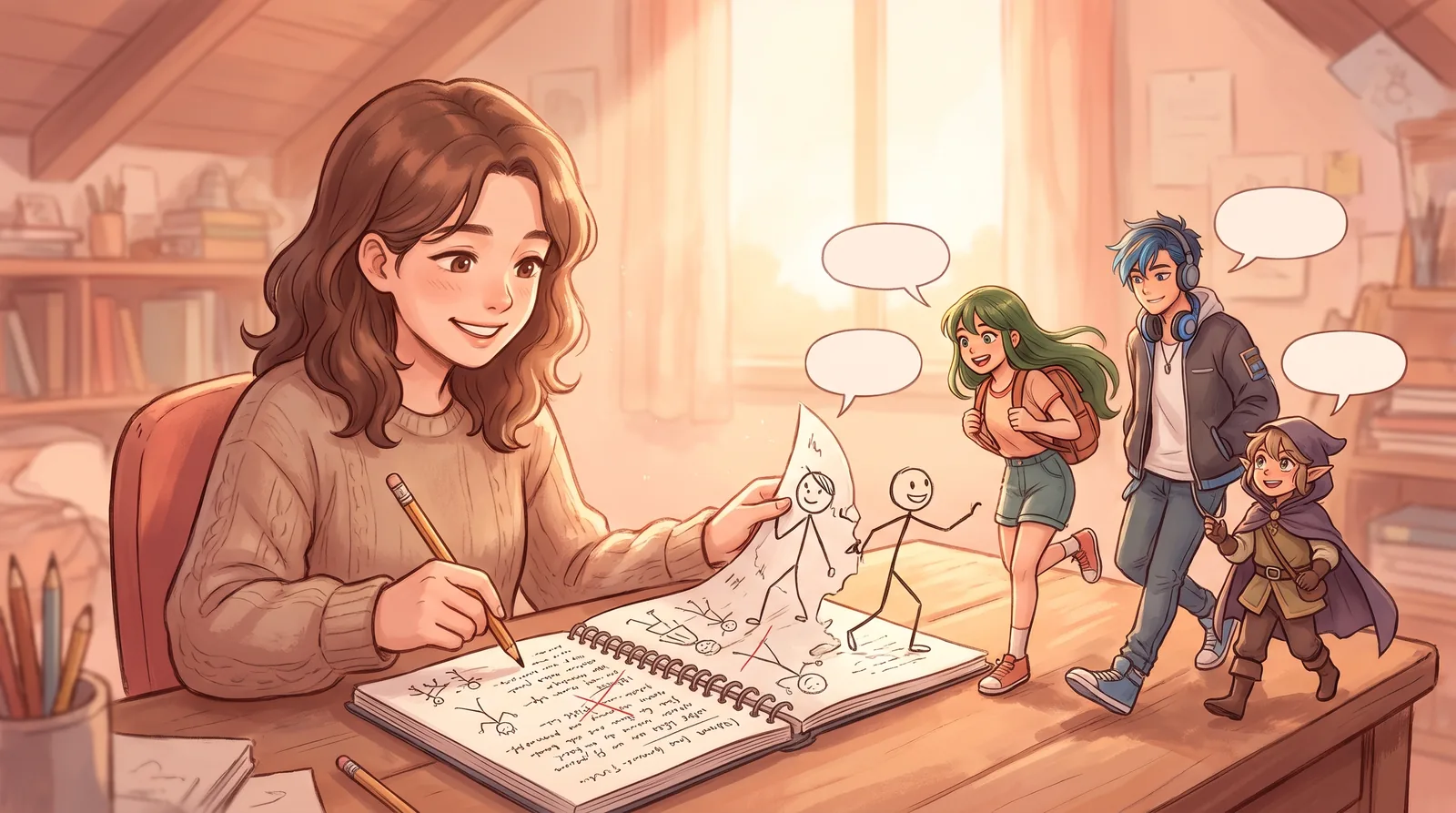
Plenty of beloved manga were written by one person and drawn by another. The writer’s job, deciding what happens, who says what and what the reader sees in each panel, is a craft of its own. If you can do that, you can make manga.
Here is the path, from a story in your head to pages you can share.
The writer’s path to a finished page
Write the scene first, as prose. Two paragraphs is enough. What happens, how it feels, where it ends.
Break it into panels. One action or one line of dialogue per panel. A page usually holds three to seven.
Describe each panel like a camera. “Wide shot: the empty bus stop in rain. Close-up: her hand on the unopened umbrella.” Pictures, not feelings.
Write the words last. Speech bubbles are short. If a line needs more than two bubbles, split it across panels.
Let the art come to you. Hand the panel script to an artist, or to MangaOra, which draws the page with your words in the bubbles.
What still needs you
AI can draw. It can’t decide what your story is about. These stay yours:
- Taste. Picking which take is right, and asking for another when it isn’t.
- Pacing. Knowing when a page needs one huge panel or six small ones.
- Consistency. Making sure the scar is on the left cheek every time. MangaOra keeps a character sheet for this.
- Fixing the small things. A hand that looks wrong, a sign with the wrong word. Circle it and fix just that spot.
See your story drawn tonight
Start with one line and MangaOra drafts your cast and draws page one. The first 10 image credits are free, no card needed. If you already have a finished story, you can adapt it chapter by chapter.
Questions people ask
Can I make a manga if I can’t draw?
Yes. Many manga are written by one person and drawn by another. If you can write the story and the panel script, you can work with an artist or use AI tools like MangaOra to draw the pages.
Is AI manga good enough to share?
It can be, if you direct it. Fix the details that are off, keep characters consistent with sheets, and choose the best take for each page.
Do I need to learn panel layouts?
A little helps. Knowing that big panels slow the reader down and small ones speed them up gives you control over pacing.